
Running a real estate investment business without the right software is like navigating a city without a map. You get somewhere eventually, but you waste time, make wrong turns, and miss opportunities that a clearer view would have revealed. Today, hundreds of platforms exist to help US-based investors manage properties, track capital, communicate with investors, and report performance. The challenge is not finding software. The challenge is finding the right one for your business.
This guide breaks down exactly how to do that.
Why the Right Software Choice Matters More Than Ever
The commercial real estate investment landscape has shifted significantly. General partners, fund managers, and asset managers face growing pressure from investors who expect faster reporting, cleaner data, and more transparent communication. Manual spreadsheets and fragmented tools no longer meet that standard.
Additionally, the cost of choosing the wrong platform is high. Enterprise solutions now range from $650 to over $18,000 per month, and implementation costs can represent 10 to 50 percent of annual fees. Therefore, selecting the right platform from the start saves money, time, and investor confidence.
The good news is that the software market has matured. You no longer have to compromise on functionality, usability, or price. You just need to know what to look for.
Understand Your Business Type First
Before comparing platforms, be honest about what kind of business you operate. The software that works for a family office managing a dozen multifamily properties is very different from what an institutional GP raising capital across multiple funds needs.
Ask yourself these questions before you evaluate any platform:
- Do you manage residential, commercial, or mixed-use properties?
- Are you raising capital from outside investors or managing your own funds?
- How many properties or units are in your current portfolio?
- How many investors do you report to, and how often?
- Do you need the platform to integrate with existing property management tools?
Your answers will narrow the field considerably. A small operator with under 50 units and a handful of investors needs simplicity and affordability. A mid-market firm with multiple syndications needs automation, custom reporting, and a polished investor portal. An enterprise-level fund manager needs GAAP-compliant accounting, multi-entity consolidation, and deep compliance workflows.
The Core Features Every Platform Should Offer
Regardless of your business size, certain features form the foundation of any capable investment management platform. Use this checklist when evaluating any solution.
| Feature | What to Look For |
| Investor Portal | Clean, mobile-friendly interface where investors can view documents, distributions, and performance data |
| Capital Account Tracking | Accurate tracking of contributions, allocations, and balances at the investor and entity level |
| Distribution Management | Automated waterfall calculations and electronic payment processing |
| Reporting and Analytics | Customizable dashboards with portfolio, property, and unit-level performance data |
| Document Management | Secure storage and sharing of K-1s, PPMs, subscription agreements, and tax forms |
| CRM and Communication | Integrated tools to track investor relationships, send updates, and manage deal pipelines |
| Compliance Tools | Investor accreditation workflows, eligibility tracking, and audit-ready documentation |
| Integrations | Connections to property management software, accounting tools, and banking platforms |
| Cloud-Based Access | Secure, encrypted access from any device with 24/7 availability and data recovery |
| Scalability | Ability to grow from a small portfolio to a large fund without switching platforms |
If a platform cannot deliver all ten of these features at your required level of depth, it is worth questioning whether it is a true long-term solution.
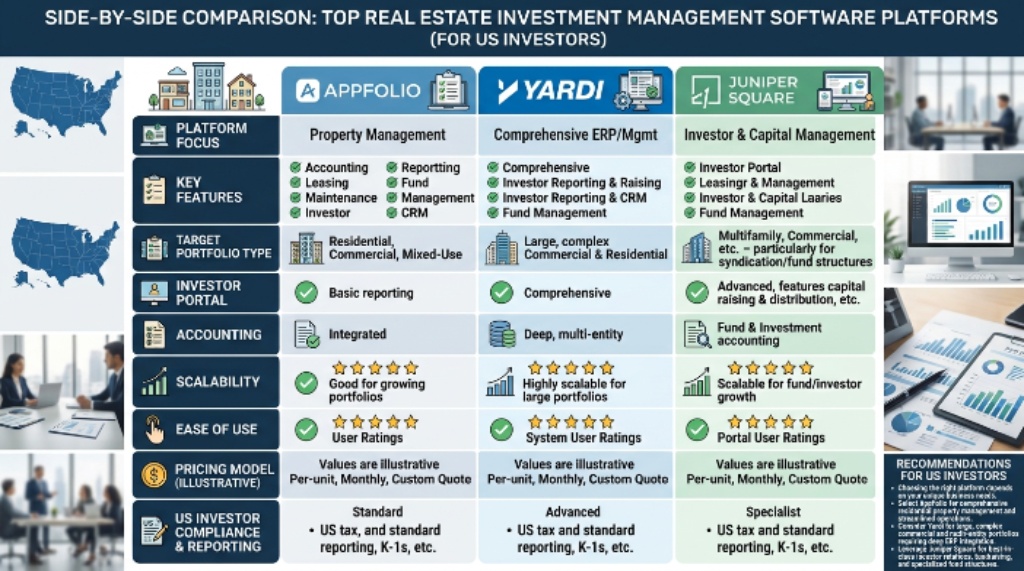
Leading Platforms in the US Market
Here is an honest overview of the platforms most commonly evaluated by US-based real estate investment firms in 2026.
| Platform | Best Suited For | Starting Price (Monthly) |
| AppFolio Investment Manager | Firms wanting seamless property and investment management integration | From $650 |
| Yardi Investment Manager | Enterprise firms needing deep accounting and GAAP compliance | Custom (from $1/unit) |
| Juniper Square | Large firms or those scaling capital-raising operations | Custom (contact sales) |
| InvestNext | Cost-effective, all-in-one solution with rapid onboarding | Custom (contact sales) |
| Agora | Highly customizable platform with 5,000+ prebuilt integrations | From $749 |
| Covercy | Firms that need built-in banking and instant LP payment transfers | Free tier available |
| SponsorCloud | Sponsors needing white-labeled, full-cycle deal management | Contact sales |
| Cash Flow Portal | Firms seeking affordable syndication and investor relations tools | Contact sales |
No single platform wins for every business. AppFolio Investment Manager leads on the combination of investor portal quality and property management integration, holding a 4.5 out of 5 rating on G2 and a 4.7 on Capterra. Yardi delivers exceptional depth in financial architecture and is particularly strong for multi-entity portfolios spanning diverse asset classes. Juniper Square is widely used by large capital-raising firms managing private equity and commercial real estate funds. InvestNext stands out for smaller sponsors who need a fast, affordable start. Agora is the strongest option for firms that need custom workflows and broad third-party integrations.
Key Factors to Weigh When Making Your Decision
Total Cost of Ownership
The sticker price is rarely the full cost. Factor in implementation fees, onboarding and training time, data migration costs, and any ongoing customization work. A platform priced at $650 per month that takes six months to configure and requires a specialist to maintain may cost far more than one priced at $1,500 that is ready to use within two weeks.
Ease of Use for Your Team and Your Investors
Software that your team finds confusing will not be used properly. Software that your investors find difficult will damage trust. When evaluating platforms, request a live demo and pay attention to how quickly someone unfamiliar with the tool can navigate the core workflows. Most platforms offer a trial period or sandbox environment. Use it.
Integration Compatibility
Many US-based real estate firms already use property management tools like AppFolio Property Manager, Yardi Voyager, MRI Software, or Rent Manager on the operations side. If you switch to a new investment management platform, it needs to connect cleanly with your existing stack. A platform that requires manual data entry between systems will create errors and slow your team down.
Investor Experience Quality
Your investors judge you partly by how easy it is to access information, sign documents, and receive distributions. A polished investor portal with clear dashboards, downloadable reports, and simple e-signature workflows signals professionalism and builds confidence. Ask to see the investor-facing side of the platform, not just the back-end tools.
Compliance and Security
US real estate syndications operate under specific regulatory requirements, including investor accreditation verification, subscription agreement management, and accurate K-1 preparation. Choose a platform that has built-in compliance workflows and handles these requirements automatically. Additionally, prioritize platforms with strong data encryption, role-based access controls, and auditable activity logs.
Scalability Path
The right platform for your business today should still be the right platform when your portfolio doubles. Some tools are built for simplicity at small scale but require a full migration as you grow. Others are enterprise-grade from day one but are unnecessarily complex for a firm with fewer than 20 investors. Be honest about where you expect to be in three years, and choose a platform that can get you there without forcing a disruptive switch.

Red Flags to Watch Out For
Not every platform delivers on its promises. Watch for these warning signs during your evaluation process.
- Pricing that is not transparent and requires multiple calls to get a real quote
- Investor portals that are not mobile-friendly or require login help from your team
- Limited reporting customization that forces you back to spreadsheets for anything complex
- Poor customer support response times, especially for implementation questions
- No clear data export option, which creates vendor lock-in and makes future migrations difficult
A Practical Evaluation Checklist
Before making a final decision, run every shortlisted platform through this process.
- Request a live demo with your own data or a realistic sample scenario
- Ask the vendor how many US-based clients of similar size and type they currently serve
- Test the investor portal experience from the perspective of a real investor
- Confirm integration compatibility with your existing tools
- Get a complete breakdown of all costs, including setup, training, and annual increases
- Check verified reviews on G2, Capterra, and Software Advice from users in your market segment
- Ask about the platform’s roadmap and what new features are planned for the next 12 months
Conclusion
Choosing the right real estate investment management software is one of the most important infrastructure decisions your business will make. The wrong choice costs money, creates confusion, and erodes investor trust. The right choice automates repetitive work, sharpens your reporting, and helps you raise and deploy capital more effectively. Start by defining your business type and size. Then assess platforms based on core features, total cost of ownership, ease of use, integration compatibility, investor experience quality, compliance tools, and scalability. Platforms like AppFolio, Yardi, Juniper Square, InvestNext, Agora, and Covercy each lead in different areas of the market. Use the comparison tables and evaluation checklist in this guide to narrow your options and make a confident, well-informed choice.
Frequently Asked Questions
What is real estate investment management software and who needs it?
Real estate investment management software helps general partners, fund managers, and asset managers oversee capital raising, investor relations, distributions, reporting, and compliance in one centralized platform. It is used by US-based real estate syndicators, private equity real estate firms, and commercial property investors who manage capital from outside investors or across multiple entities.
How much does real estate investment management software cost in the US?
Pricing varies widely based on portfolio size and functionality. Entry-level platforms start at around $650 per month for growing firms, while enterprise-grade solutions can cost $18,000 or more per month. Implementation and onboarding costs can add 10 to 50 percent on top of annual fees. Some platforms, like Covercy, offer free tiers for smaller portfolios.
What is the difference between property management software and investment management software?
Property management software handles day-to-day operations such as rent collection, maintenance, and tenant communications. Investment management software focuses on the capital side of the business, including investor portals, waterfall distributions, capital account tracking, fund reporting, and compliance workflows. Some platforms, like AppFolio and Yardi, offer both within a connected ecosystem.
What features are most important for a real estate syndicator just starting out?
Syndicators launching their first deals should prioritize a clean investor portal, simple distribution management, subscription agreement and document handling, and investor accreditation tracking. Cost-effectiveness and fast onboarding matter more at this stage than deep enterprise-level customization. Platforms like InvestNext and Cash Flow Portal are commonly chosen at this stage.
How long does it take to implement new investment management software?
Implementation timelines vary by platform complexity and portfolio size. Simple platforms can be live within a few days to two weeks. Enterprise solutions with custom configurations, data migrations, and team training can take two to six months. Always ask vendors for a realistic implementation timeline before signing a contract, and confirm what support is included during the setup process.