
Small business accounting services cover bookkeeping, payroll, tax filing, financial reporting, and advisory support that help business owners track money, stay compliant, and make decisions based on real data.
In 2026, these services matter more than ever. Small businesses face tighter margins, more digital transactions, and frequent tax and compliance updates. At the same time, owners are expected to act as operators, marketers, and strategists. Accounting is no longer a back-office task. It directly affects cash flow, funding access, and survival.
According to industry surveys from the past few years, over 60% of small businesses now use some form of outsourced accounting or external bookkeeping services. The reason is simple. Owners want accurate numbers without hiring, training, and managing an in-house team.
This shift is not about cutting corners. It is about getting reliable expertise at a predictable cost while staying focused on growth.
What Problem Are Small Businesses Facing With In-House Accounting?
Short answer: In-house accounting is expensive, inconsistent, and hard to scale.
Many small businesses start with spreadsheets or part-time help. As transactions grow, errors increase. Missed reconciliations, late filings, and unclear reports become common. Owners often discover problems only when cash runs tight or tax notices arrive.
Hiring a full-time accountant is not always practical. In the US, the average salary for an experienced accountant exceeds $65,000 per year, excluding benefits and software costs. For small teams, that is a heavy fixed expense.
Turnover adds another risk. When a bookkeeper leaves, knowledge leaves with them. Files may be incomplete. Processes break.
This creates stress, wasted time, and poor decisions based on outdated data.
Why Is Outsourced Accounting the Preferred Solution in 2026?
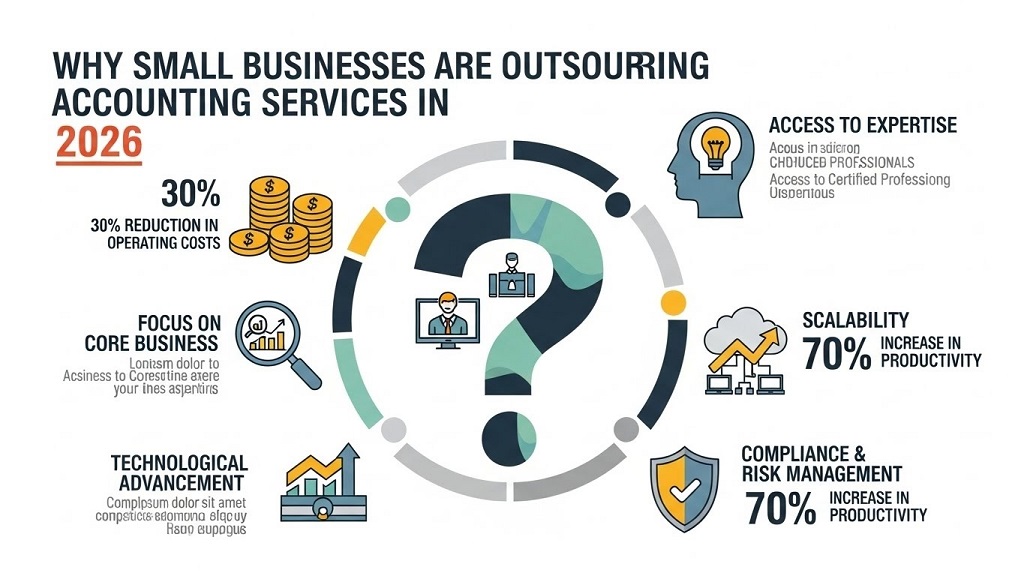
Outsourced accounting gives small businesses access to a full accounting function without the overhead of hiring.
Instead of one person, businesses get a team. That often includes a bookkeeper, a payroll specialist, and a senior accountant who reviews reports.
In 2026, outsourcing works better because of:
- Cloud-based accounting software
- Secure document sharing
- Real-time dashboards
- Standardized workflows
These tools allow external teams to work as if they were in-house, but with more structure and oversight.
How Does Outsourcing Accounting Reduce Costs for Small Businesses?
Short answer: You pay only for what you use.
With outsourced accounting, costs are usually monthly and predictable. Packages often range from $300 to $2,000 per month depending on transaction volume and services.
Compare that to in-house costs:
| Cost Item | In-House Accounting | Outsourced Accounting |
|---|---|---|
| Salary | $60,000+ | Included |
| Benefits | $8,000–$12,000 | Included |
| Software | $1,500–$3,000 | Often included |
| Training | Ongoing | Not required |
For many small businesses, outsourcing cuts accounting costs by 30–50% while improving accuracy.
How Does Outsourced Bookkeeping Improve Accuracy and Compliance?
Bookkeeping services provided by professional firms follow documented processes. Transactions are categorized consistently. Bank and credit card accounts are reconciled monthly. Reports are reviewed before delivery.
This reduces errors that often occur when accounting is handled part-time or rushed.
Compliance also improves. Outsourced teams stay updated on tax deadlines, payroll rules, and reporting standards. This lowers the risk of penalties and audits.
A 2024 case study from a US-based retail business showed a 40% reduction in accounting errors after switching to outsourced bookkeeping. Late tax filings dropped to zero within one year.
Why Are Small Business Owners Prioritizing Time Over Control?
Short answer: Time is now more valuable than direct control.
In 2026, owners want to spend time on sales, product, and customers. Accounting tasks pull them away from revenue-generating work.
Outsourcing removes daily financial admin. Owners receive clear reports instead of raw data. They review results instead of entering transactions.
This shift allows better decisions without micromanaging the process.
How Does Outsourced Accounting Support Better Cash Flow Management?
Cash flow visibility is a major reason small businesses outsource.
Professional accounting teams provide:
- Monthly cash flow statements
- Accounts receivable tracking
- Expense trend analysis
- Short-term cash forecasts
With accurate data, businesses can spot issues early. They know when to delay spending or push collections.
A service-based company with 12 employees reported that outsourced accounting helped reduce average payment delays by 18 days within six months.
What Role Does Technology Play in Outsourced Accounting in 2026?
Technology is the backbone.
Outsourced accounting firms use cloud platforms for bookkeeping, payroll, and reporting. Automation handles repetitive tasks like data entry and invoice matching.
This leads to:
- Faster month-end closes
- Real-time financial dashboards
- Secure access from anywhere
Small businesses benefit from advanced tools without paying enterprise-level costs.
How Does Outsourcing Improve Financial Decision-Making?
Short answer: Better data leads to better decisions.
Outsourced accounting teams do more than record transactions. They explain numbers.
Owners receive insights on:
- Profit margins by product or service
- Rising cost categories
- Seasonal revenue patterns
This supports pricing changes, hiring plans, and investment decisions.
Is Outsourced Accounting Secure and Reliable?
Yes, when done correctly.
Reputable providers use encrypted systems, access controls, and regular audits. Data backups and disaster recovery plans are standard.
In many cases, outsourced accounting is more secure than local spreadsheets or single-user systems.
Which Types of Small Businesses Benefit Most From Outsourcing?
Outsourcing works well for:
- Service-based businesses
- Ecommerce stores
- Startups and growing companies
- Remote-first teams
Any business that needs reliable financial data without building a finance department is a good fit.
How Do You Choose the Right Outsourced Accounting Partner?
Start with experience and transparency.
Look for providers that:
- Specialize in small business accounting services
- Offer clear pricing
- Provide dedicated support
- Use modern accounting software
Ask for sample reports and service-level details before committing.
What Is the Long-Term Impact of Outsourcing Accounting?
Short answer: More stability and better growth decisions.
Businesses that outsource accounting often scale faster. Financial processes are already in place. Reporting improves as volume grows.
This reduces friction when applying for loans, attracting investors, or planning expansion.
Conclusion: Should Your Business Outsource Accounting in 2026?
Outsourcing accounting is no longer a trend. It is a standard operating choice for small businesses in 2026.
Rising costs, complex compliance, and the need for real-time insights make in-house accounting less practical for many teams. Small business accounting services delivered through outsourcing offer accuracy, flexibility, and control without the overhead.
If your financial tasks consume time, create stress, or limit growth, outsourcing is worth serious consideration.
Call to Action: Review your current accounting setup. Identify gaps. Talk to a professional provider. The right partner can turn your numbers into a growth tool instead of a burden.
Frequently Asked Questions
What are small business accounting services?
They include bookkeeping, payroll, tax preparation, financial reporting, and advisory support designed for small businesses.
Is outsourced accounting better than hiring in-house?
For many small businesses, yes. Outsourcing offers lower costs, better accuracy, and access to a full team.
How much do outsourced bookkeeping services cost?
Most small businesses pay between $300 and $2,000 per month depending on size and needs.
Is my financial data safe with outsourced accounting?
Reputable firms use secure cloud systems, encryption, and strict access controls.
Can outsourced accounting scale with my business?
Yes. Services can expand as transaction volume and complexity increase.
Do startups benefit from outsourced accounting?
Startups benefit greatly by avoiding early hires and maintaining clean financial records.
What should I look for in an outsourced accounting provider?
Experience with small businesses, clear pricing, strong communication, and modern tools.
Related Topics: Why Are Small Business Owners Missing Thousands in Tax Deductions?
Related Topics: How to get a better sleep in your hotel room
