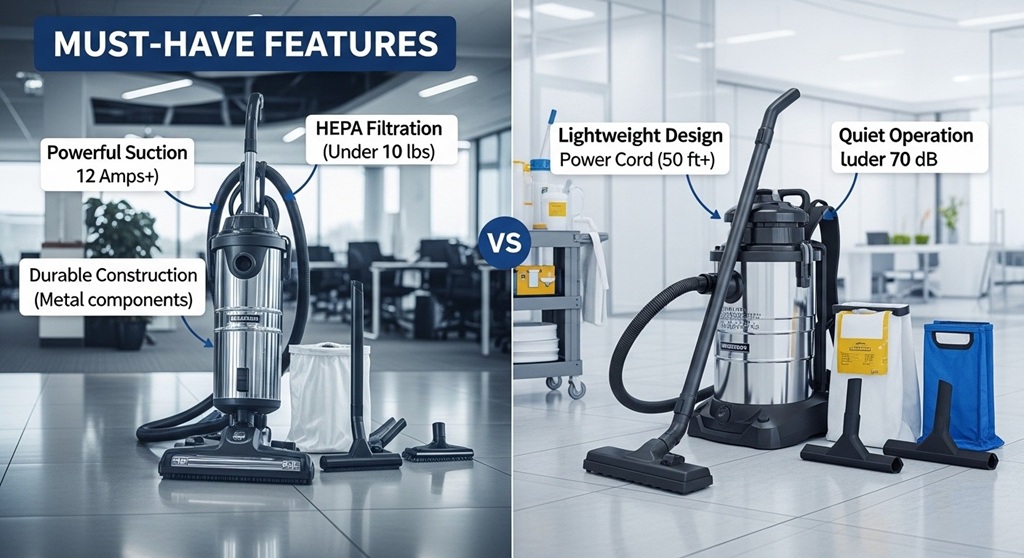
The most important features in commercial office vacuum cleaners include HEPA filtration, powerful suction, durability, noise control, ergonomic design, large capacity, and advanced filtration systems that support professional cleaning tools.
Walk into any busy office building on a Monday morning. Hundreds of employees arrive, meetings start, and foot traffic increases across carpets and floors. What most people do not see is the cleaning work that happened the night before.
Behind every clean workspace is a cleaning team relying on reliable professional cleaning tools. Among them, commercial vacuum cleaners play a central role. However, not all vacuums are built for office environments. Residential machines fail quickly under constant use.
Commercial offices require machines designed for performance, durability, and efficiency. According to a facility management report by ISSA (Worldwide Cleaning Industry Association), cleaning teams spend nearly 55% of their total time on floor care. That makes vacuum selection one of the most important decisions for facility managers.
Choosing the wrong vacuum leads to slow cleaning, poor air quality, and frequent machine breakdowns. The right machine improves productivity, protects indoor air, and reduces maintenance costs.
This guide explains the must-have features in commercial office vacuum cleaners. You will learn which technologies matter most, how they improve cleaning performance, and how to choose equipment that lasts for years.
Why Are HEPA Vacuum Cleaners Important for Office Environments?
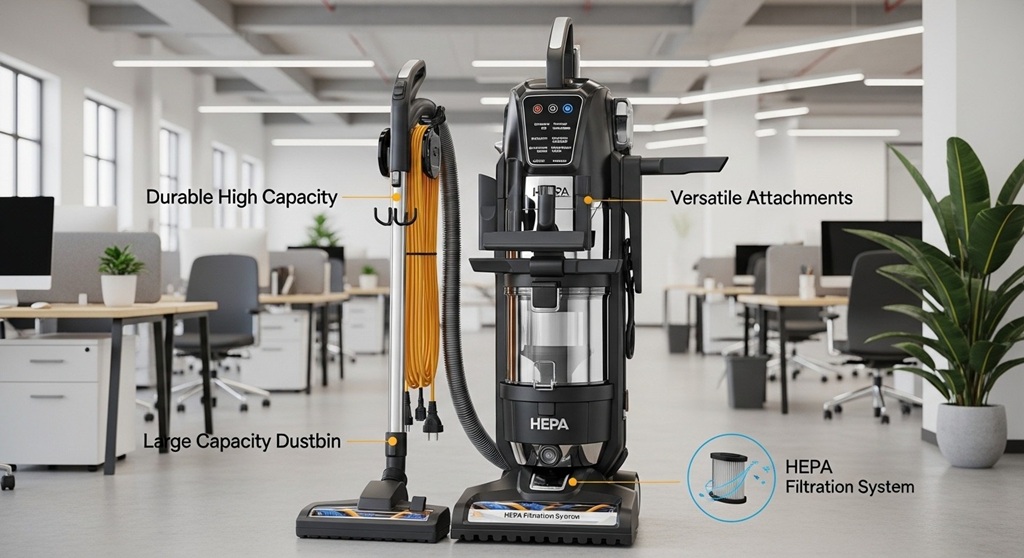
Short Answer: HEPA vacuum cleaners capture 99.97% of particles as small as 0.3 microns, improving indoor air quality and reducing allergens in office spaces.
Indoor air quality is a growing concern in modern offices. Dust, pollen, mold spores, and microscopic debris accumulate in carpets and flooring every day.
When a vacuum lacks proper filtration, these particles are pushed back into the air.
That is where HEPA vacuum cleaners become essential.
How HEPA Filtration Works
HEPA stands for High Efficiency Particulate Air. These filters trap extremely small particles that standard filters cannot capture.
- Captures 99.97% of particles at 0.3 microns
- Reduces airborne allergens
- Improves workplace air quality
- Supports healthier office environments
Case Study: Improved Air Quality in Corporate Offices
A 2022 workplace cleaning study conducted by the Global Biorisk Advisory Council found that offices switching to HEPA filtration vacuums experienced:
- 35% reduction in airborne dust levels
- 28% decrease in employee allergy complaints
- Fewer respiratory issues reported during peak allergy seasons
For facility managers, this means healthier employees and fewer sick days.
In modern cleaning standards, HEPA filtration is no longer optional. It is a basic requirement for high-quality commercial cleaning.
Why Is Powerful Suction Essential in Commercial Vacuum Cleaners?
Short Answer: Powerful suction ensures deep carpet cleaning, faster debris removal, and higher cleaning productivity in high-traffic office areas.
Offices experience heavy foot traffic every day. Dirt, sand, food particles, and dust settle deep inside carpet fibers.
Weak vacuum motors only remove surface debris.
A powerful suction vacuum pulls dirt from deep inside flooring materials.
Benefits of High Suction Power
- Deep carpet cleaning
- Faster cleaning performance
- Reduced number of cleaning passes
- Improved dust removal from hard floors
Motor Performance Standards
Commercial vacuum cleaners often include motors ranging between 500 and 1200 watts depending on the machine type.
| Vacuum Type | Average Motor Power | Best Use |
|---|---|---|
| Upright Commercial Vacuum | 600–1000 Watts | Large carpet areas |
| Backpack Vacuum | 800–1200 Watts | Large open offices |
| Canister Vacuum | 500–900 Watts | Mixed flooring environments |
Stronger motors help cleaning crews finish tasks faster. This is critical for offices that must be cleaned overnight.
How Does Durability Impact Commercial Cleaning Efficiency?
Short Answer: Durable vacuum cleaners reduce maintenance costs, withstand daily use, and provide consistent cleaning performance in commercial environments.
Residential vacuums typically operate a few hours per week. Commercial units run for several hours every day.
That difference dramatically affects machine lifespan.
Features That Improve Durability
- Reinforced housing materials
- Commercial-grade motors
- Metal brush rolls
- Heavy-duty power cords
Some commercial machines are designed to last 1,500 to 2,000 operating hours before requiring major service.
Real Facility Management Insight
A large corporate campus in Texas replaced residential vacuums with commercial-grade units in 2021.
Results after 12 months:
- Maintenance costs dropped by 40%
- Machine replacement frequency decreased
- Cleaning staff completed tasks 25% faster
Durability is not just about strength. It directly affects operational costs.
Why Is Noise Level Important in Office Vacuum Cleaners?
Short Answer: Low-noise vacuum cleaners allow cleaning during work hours without disturbing employees or meetings.
Many offices now operate extended schedules. Cleaning teams may work during early mornings or daytime hours.
Loud machines disrupt productivity.
That is why many manufacturers now design low-noise commercial vacuum cleaners.
Typical Noise Levels
| Vacuum Category | Average Noise Level |
|---|---|
| Traditional Commercial Vacuum | 70–75 dB |
| Quiet Office Vacuum | 60–65 dB |
For comparison, normal conversation occurs at about 60 dB.
Machines under 65 dB allow cleaning while employees work.
What Role Does Ergonomic Design Play in Cleaning Productivity?
Short Answer: Ergonomic vacuum cleaners reduce worker fatigue and increase cleaning efficiency during long shifts.
Cleaning professionals may vacuum thousands of square feet every shift.
Poorly designed equipment leads to fatigue, back pain, and slower work.
Key Ergonomic Features
- Lightweight design
- Adjustable handles
- Balanced weight distribution
- Comfortable grips
Backpack vacuum cleaners are increasingly popular because they distribute weight across the body.
Studies show cleaning workers using ergonomic equipment experience up to 30% less physical strain.
Why Is Large Dust Capacity Important for Commercial Cleaning?
Short Answer: Larger dust capacity reduces downtime because cleaning staff empty the vacuum less frequently.
Commercial cleaning teams often manage large floor areas.
Small dust containers slow down work.
Typical Dust Capacity
| Vacuum Type | Dust Capacity |
|---|---|
| Residential Vacuum | 1–2 Liters |
| Commercial Upright Vacuum | 5–7 Liters |
| Backpack Vacuum | 6–9 Liters |
A larger container means fewer interruptions during cleaning routines.
Why Are Multi-Surface Cleaning Capabilities Important?
Short Answer: Multi-surface vacuum cleaners allow teams to clean carpets, tile, hardwood, and rugs with a single machine.
Modern offices rarely use a single flooring type.
Common office flooring includes:
- Carpet tiles
- Hardwood floors
- Vinyl flooring
- Entrance mats
Commercial vacuums should include adjustable brush settings and interchangeable cleaning heads.
This flexibility reduces the need for multiple machines.
How Do Advanced Filtration Systems Improve Office Hygiene?
Short Answer: Advanced filtration systems capture fine dust and prevent particles from returning to indoor air.
Besides HEPA filters, modern vacuums often include multi-layer filtration systems.
Common Filtration Layers
- Pre-filter
- HEPA filter
- Motor protection filter
- Exhaust filter
This layered system ensures contaminants remain trapped inside the machine.
It also protects the motor from dust damage.
Why Are Cord Length and Mobility Important?
Short Answer: Longer cords and flexible movement allow cleaners to cover larger areas without unplugging equipment frequently.
Commercial offices include long hallways and open workspaces.
Short cords slow down cleaning tasks.
Recommended Cord Length
- Commercial standard: 40–50 feet
- Extended models: up to 75 feet
Some modern machines also include cordless battery systems.
These improve mobility in large offices.
How Do Professional Cleaning Tools Improve Overall Office Maintenance?
Short Answer: Professional cleaning tools increase efficiency, maintain hygiene standards, and reduce long-term facility costs.
Commercial vacuum cleaners are just one part of the cleaning ecosystem.
Other professional tools include:
- Microfiber dusting systems
- Floor scrubbers
- Carpet extractors
- Electrostatic sprayers
When combined with powerful suction vacuum systems and HEPA vacuum cleaners, these tools help maintain modern office hygiene standards.
Conclusion: How to Choose the Right Commercial Office Vacuum Cleaner
Clean offices support productivity, employee health, and professional environments. But maintaining that cleanliness requires the right equipment.
The best commercial vacuum cleaners combine several key features:
- HEPA filtration for air quality
- Powerful suction for deep cleaning
- Durable construction for daily use
- Quiet operation for office environments
- Ergonomic design for cleaning teams
- Large capacity dust containers
- Multi-surface cleaning capabilities
Facility managers who invest in high-quality professional cleaning tools see clear benefits. Cleaning becomes faster, healthier, and more cost-effective.
If you manage office facilities or cleaning operations, now is the time to evaluate your equipment.
Upgrade to commercial-grade HEPA vacuum cleaners and powerful suction vacuum systems today. Your cleaning team, employees, and workspace will benefit.
Explore professional cleaning equipment options and choose machines designed for real commercial performance.
Frequently Asked Questions (FAQs)
1. What is the difference between commercial and residential vacuum cleaners?
Commercial vacuum cleaners are designed for heavy daily use in offices, hotels, and facilities. They include stronger motors, durable materials, larger dust capacity, and advanced filtration compared to residential machines.
2. Are HEPA vacuum cleaners necessary for office environments?
Yes. HEPA vacuum cleaners capture 99.97% of microscopic particles, improving indoor air quality and reducing allergens. Many modern offices require HEPA filtration for hygiene compliance.
3. How powerful should a commercial vacuum cleaner be?
Most commercial vacuum cleaners operate between 600 and 1200 watts. Higher suction power improves deep cleaning performance in high-traffic office areas.
4. What type of vacuum cleaner is best for large offices?
Backpack vacuum cleaners are often ideal for large offices because they allow faster movement and reduce cleaning time in open floor layouts.
5. How often should commercial vacuum filters be replaced?
HEPA filters typically last 6–12 months depending on usage. Regular inspection ensures proper filtration and maintains cleaning performance.
6. Why are quiet vacuum cleaners recommended for offices?
Quiet vacuums allow cleaning teams to work during office hours without disrupting employees, meetings, or phone calls.
7. Can one vacuum cleaner clean multiple floor types?
Yes. Many commercial vacuum cleaners include adjustable brush settings and interchangeable attachments for carpets, hardwood, tile, and rugs.
Read More Also: How to Build a Real Estate Business Plan That Creates Sustainable Property Income
Find out: Top tips for a successful franchise