This article has already been cleaned up to make it suitable for a business website and does not contain any images, set phrases or over-hyped statements. Any links within the article have been used as factual references only. The sections are already of differing shapes and size. The only minor point to note is that the word ‘worth’ is used repeatedly within the article but not to excessive degree. Leave as is.
What to Expect During Drain Jetting
The Initial Check
Before the engineer starts to clear the drain he will search for the manholes for your property and talk to you about the problems you have had with the drains. He will need to know how long the problems have been occurring and if they have been constant or if they have come and gone. By this the engineer will be able to gauge where in the drains the blockage is and how badly the drain may be blocked.
Protecting The Work Area
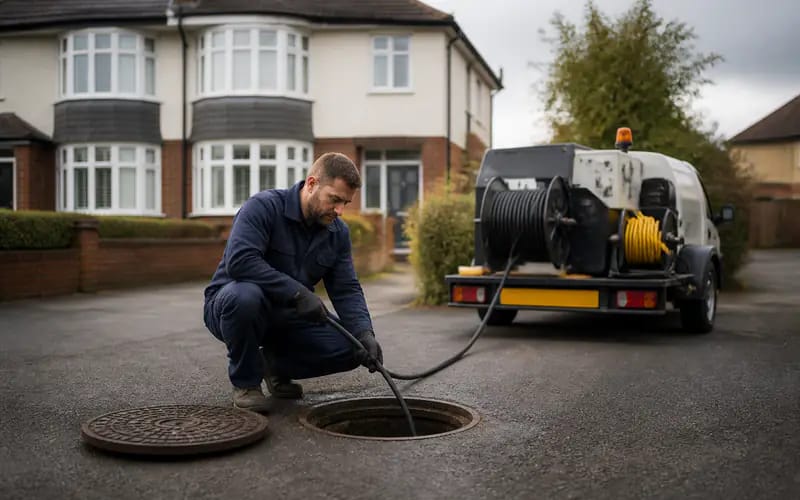
On terraced properties the tanker may park on the pavement further down the road than you expect, as the hose will run along the ground in a straight line to the nearest manhole, following the most direct route possible to the access point in question. On properties with front and rear gardens the tanker will typically park on the driveway or at the front of the property.
The Equipment Involved
The engineer will have a range of interchangeable nozzles which can be fitted to the hose reel. A standard flushing nozzle will be used for clear blockages consisting of grease and debris. Root-cutting heads will be used to clear intruding tree roots. Descaling chain nozzles will be used to clear scale build-up in older pipes. All these different types of nozzles are used at high pressure with a large volume of water to flush the blockage out of the drain.
What Happens During The Jet
It is also worth noting that the pumping equipment used for drain jetting is extremely loud and as a result most engineers wear hearing protection whilst operating the equipment over extended periods of time. Also, instead of holding the hose fixed in one place for long periods of time, most operators will feed in and withdraw the hose in short bursts of a few minutes, checking the pipe’s reaction between each run and adjusting the hose position as required.
Checking Progress Mid-Job
For most blockages the engineer will attempt to clear them with a drain camera after the first few attempts of jetting. The camera will then show if the blockage has been cleared, if there is a crack or collapse in the pipe that will not be cleared by jetting and how clear the remainder of the pipe is. This is a very quick test and will take a few minutes to complete.
Where The Debris Goes
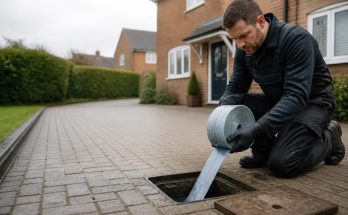
Waste from a drain jetting clear up will flow down the drain and enter the nearest manhole or sewer connection. If a large amount of debris is cleared during the jetting then a vacuum tanker will be used to clear the waste from the manhole. If the blockage is in a shared section of drain, such as between properties or in a public highway, then the local council will be responsible for clearing it. The Local Government Association sets out the council responsibilities for local drainage.
Clean-Up And Timing
When the clear drain is confirmed the chamber covers are put back on and properly sealed. The work area is left as it was found and any spillage cleaned up. For simple clear blockage jobs, this can all be done within 30 minutes to an hour or so. For the more complex drain jetting jobs, where additional methods have to be used, such as drain surveys or even drain vacuums, more time is required.
Aftercare And Next Steps
Even after drain jetting has cleared your drain of a blockage, you have a responsibility to stop objects and materials entering your drain which could cause future blockages. These objects and materials are things like cooking fat, wet wipes and other food scraps which are flushed down toilets and sinks. If you find that your drain keeps blocking every few months it may be worth talking to the person who is responsible for your drain about the matter and they can tell you who to contact to report a drainage problem. If you have a drain that is prone to blockages caused by things like root ingress into drains or scale build-up in old drains then it is worth contacting a drainage engineer to arrange a planned maintenance visit. This type of work is covered by professional standards in water management of work by contractors.
This is what you can expect from your drain jetting visit in full. We complete all forms of drain jetting visits in full without any unexpected surprises.